Icare’ 2’s 30th Anniversary

Dean Sigler Announcements, Batteries, hydrogen, Hydrogen Fuel, Solar Power, Sustainable Aviation Leave a Comment

As  Icare’ 2 continues exploration of advanced aerodynamics, Karl Kaeser, CEO of Kasaero GmbH, reminds us of an important event in electric aviation, the 30th anniversary of Icare’ 2. Editor’s note.  Karl Kaeser made the following clarification (Seprember 3): “I have never been really involved with the Icaré aircraft. I’d rather see the name of Professor Vot-Nitschmann there or Werner “micro” Scholz.  As for the e-Genius Professor Voit-Nitschmann was also for the Icaré the leader of the design group. And micro was the research assistant who brought the Icaré to reality.”   “Exactly 30 years ago today (July 1), electric flight took off at the University of Stuttgart! “On 1 July 1996, the Icaré 2 successfully completed its maiden flight – a solar-electric motor glider developed at the University of Stuttgart – Institute of Aircraft Design (IFB). What may have seemed visionary at the time has since become part of a much larger story: three decades of research into electric flight. …

Klaus Ohlmann, Jonas Lay and eGenius go 2003 kilometers

Dean Sigler Announcements, Electric Powerplants, Hybrid Aircraft, hydrogen, Hydrogen Fuel, Sustainable Aviation Leave a Comment

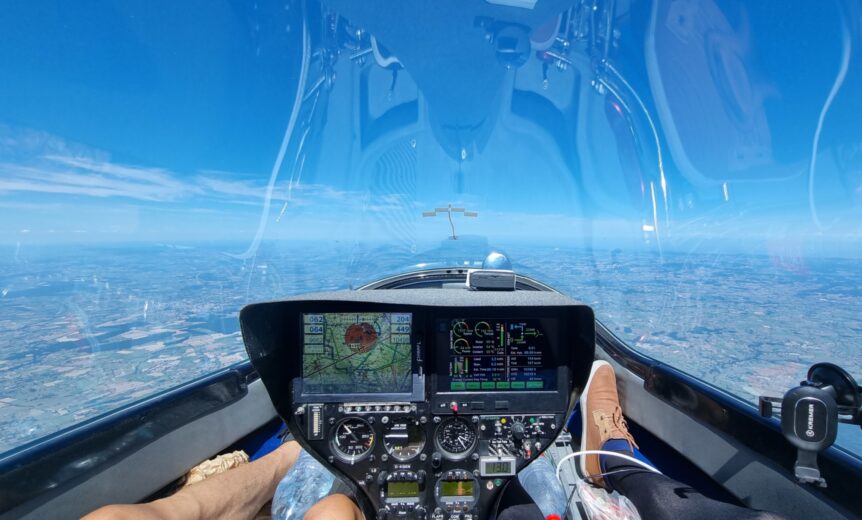
Klaus Ohlmann and Jonas Lay in the one-and-only eGenius just completed a 2,003 kilometer (1,244 mile) trip from Germany to the Atlantic Ocean on the southern tip of France and return.  The numbers are spectacular.  The flight averaged 190.36 kilometers per hour (118.28 mph) and its hybrid power system consumed a mere 81 liters of fuel.  That works out to 24.72 kilometers per liter or 58.15 mpg.  Even a Prius at that speed would guzzle gasoline. Hybridizing eGenius eGenius was to have originally been HydroGenius, flying on gaseous hydrogen.  Starting design in 2006 and as presented at the 2009 Electric Aircraft Symposium, HydroGenius was designed by Rudolf Voit-Nitschman, Len Schumann, and Steffen Geinitz of the IFB, Institute of Aircraft Design at the University of Stuttgart.  Because Mercedes-Benz did not have their fuel cell available, the designers turned to pure battery power and the airplane became eGenius. The craft won second place in the NASA Green Flight Challenge sponsored by Google …