DARPA (the Defense Advanced Research Projects Agency) has announced a competition for ANCILLARY (AdvaNced airCraft Infrastructure-Less Launch And RecoverY eVTOLs), or electric Vertical Take Off and Landing vehicles. (That’s about as tortured an acronym as we could cram into a lead paragraph.) The goal, to develop a Class 3 unmanned VTOL aircraft capable of flying all-weather missions from ships or land, has been responded to by several industry leaders. These have been winnowed to six “finalists” who will craft demonstration models of their respective designs. DARPA’s announcement includes the following: “The UAS would be able to launch and recover from ship flight decks and small austere land locations in adverse weather without additional infrastructure equipment, thus enabling expeditionary deployments. Unlike large VTOL systems, the small UAS size would allow many aircraft to be stored and operated from one ship creating a tactical beyond-line-of-site (BLOS) multi-intelligence sensor network capability.” The Six Finalists Phase Ia of the competition reduced the number of …
Skydweller Seeks Ultra-Persistence
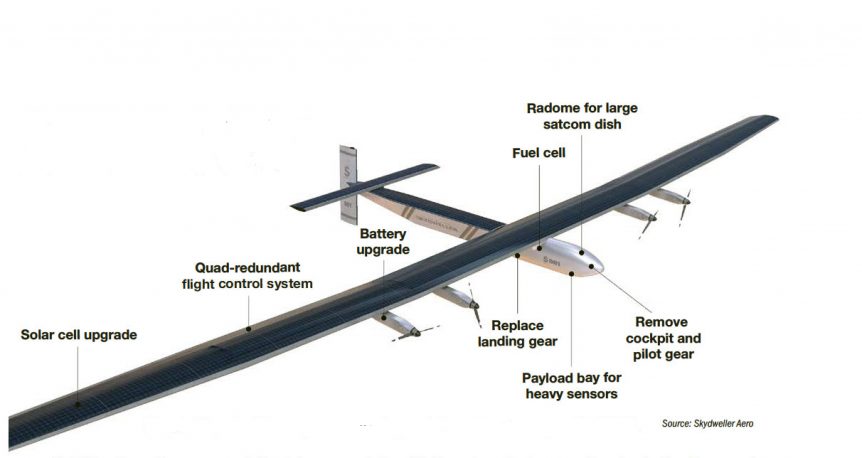
Skydweller Aero, an adaptation of Solar Impulse technologies, is working with the U. S. Navy to provide ultra-persistent flight capabilities. It’s using Solar Impulse Two, for which Skydweller purchased the assets and intellectual property rights. Being flown in Spain at this time, the aircraft’s 2,900 square feet of solar cells provide two kilowatts of power, and may be augmented by hydrogen fuel cells in future. In Spain Skydweller founders John Parkes and Robert Miller have headquarters in Oklahoma City, Oklahoma, but are performing flight tests in Spain, coordinating efforts with the University of Castilla-La Mancha (UCLM). After successfully completing ground tests that checked the structure and control systems, Skydweller works toward crafting the software that will guide it on unpiloted missions, scheduled to last at least 30 to 60 days. Such persistence, long sought by the military for ISR (Intelligence, Surveillance and Reconnaissance) missions, is also essential for many future civilian applications. Co-founder John Parkes explained this to Aviation Today. …