
Mercedes-Benz, with its YASA (Yokeless and Segmented Armature) motor, has achieved a second world record this year for power density. Pulling 1,000 horsepower from a 12 kilogram (xx pound) motor seems a bit incredible, but Mercedes has dynomometer tests to prove it. This efffort will be in production cars within a year, according to Mercedes, and the aircraft version, produced by a division called Evolito, will probably follow shortly thereafter. Even while under development at Oxford University, the motor showed great promise, as well as great torque. This blog included the video below in 2010, with a Lotus 7 copy being flung about handily with two 40 kilowatt (53.6 horsepower) YASAs driving the rear wheels. At that time, power was limited to 75 kilowatts (100.5 hp.), although designers believed 150 kW (201 hp.) was possible. That early motor weighed 11 kilograms, or 23.2 pounds, one pound per three limited horsepower, one pound per six horsepower at the design limit. As …
Koenigsegg’sTorque-Dense Electric Motor and Hybrid Drive Train
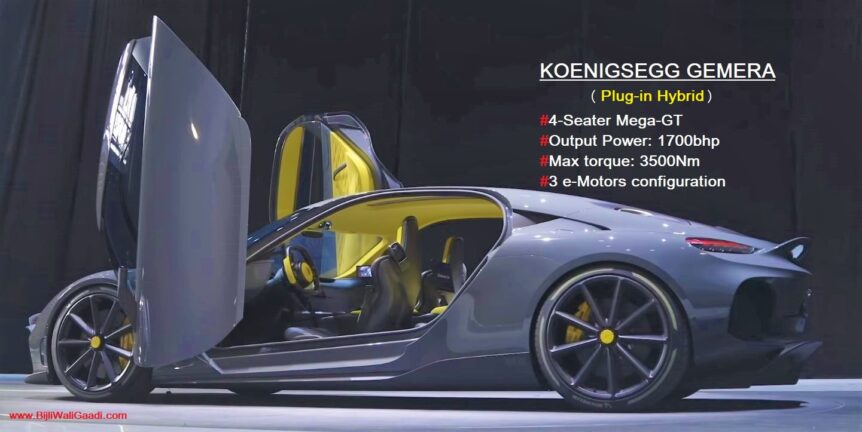
Koenigsegg (Cone-igs-egg), a Swedish car maker that enjoys shocking with its sticker prices, is going hybrid with a new, torque-dense electric motor and hybrid drive train. The Swedish car maker is known for its ultra-exclusive, ultra-high-performance vehicles, which have even undone the Stig, anonymous race driver on the BBC Series Top Gear. David Koenigsegg’s Gemera manages as much as 250 mph on a two-liter, three-cylinder engine, augmented by a set of three electric motors. Describing him as, “an inveterate tinkerer” who squeezes “extraordinary amounts of power out of internal combustion engines,” Clean Technica explains the “breakthrough products that could transform the world of electric cars.” One “breakthrough” would seem to be a package of a three-cylinder engine coupled to some powerful electric components. The “Tiny Friendly Giant (TFG) engine pumps out 600 horsepower (450 kilowatts) and weighs only 70 kilograms (154 pounds). It has no camshafts, relying instead on solenoid-actuated, artificial-intelligence-controlled valves to let the fuel and air in and …
Spider Webs and Slime Mold – Nature’s Networking Genius
As aircraft become more electrified and integrated in their operations, even light airplanes are turning to networking system such as ARINC AFDX and CANBUS to link their different operational elements (See “An LSA With the Electric Heart of an Airliner, May 24, 2010). The ability to sustain failure or damage in any one element without disrupting safe operation of other subsystems or the aircraft itself becomes a primary consideration. During the Electric Aircraft Symposium’s Friday evening dinner sessions, Dr. Svetlana Poroseva of Florida State University’s Center for Advanced Power Systems (CAPS) presented a four-minute rundown on her efforts to find a network topology that provides the necessary reliability and robustness to allow power systems or naval vessels in combat, for instance, to continue their missions with the least loss of capabilities. Her findings were that a web network, not unlike that of a spider web, allowed the greatest fault tolerance, least disruption of other services and enabled mission fulfillment. This …


