
The XPrize Foundation had a significant announcement last week, the five finalists in the Wildfire Detection and Suppression Challange. The Foundation describes the wildfire competition this way: “Competitors in the Autonomous Wildfire Response Track are developing fully autonomous solutions to detect and suppress a high-risk fire in 10 minutes or less over a large, environmentally complex area roughly the size of San Francisco, Oakland, and San Jose combined, while avoiding decoy fires—a challenge that has never been tackled at this scale and scope before. These technologies have the potential to transform how fires are detected, managed, and fought, with a rate 4x faster than current best practices and shortening the time between detection and rapid response, minimizing negative impacts.” The competition is based on two tracks with a bonus high-speed fire detection prize, again quoting from the official XPrize Wildfire web site: “Track A: Space-Based Wildfire Detection and Intelligence tests teams’ ability to detect fires across vast, environmentally challenging landscapes …
XPrize for Drones Spotting and Fighting Fires
A Firefighting Competition Like No Other Xprize has given us budget space travel, hyper-economical cars, and attempts to replicate the medical functions of Star Trek’s Tricorder. Now, the XPrize folks have turned their attentions to spotting and controlling wildfires by drones. This fits well with the Sustainable Aviation Foundation (underwriting this blog) and its concerns about spotting and controlling wildfires at the earliest opportunity. To counter this, XPrize has launched an $11 million comptetiton to, “Protect lives, forests, and the climate: Create breakthrough technologies that detect and extinguish destructive wildfires, enabling a future where people and healthy fire can safely coexist.” This challenge, promoting autonomous flight vehicles and the ability rapidly identify and extinguish incipient wildfires, initially drew 338 teams. These have been culled to 15 semifinalist groups. The Semifinalists This worldwide problem drew worldwide interest. The 15 teams are: Aerowatch of Barcelona, Spain Agni part of TRID Systems in Dresden, Germany Anduril, in Costa Mesa, California Crossfire, College Park, Maryland (see …
Things are Looking up in Dubai
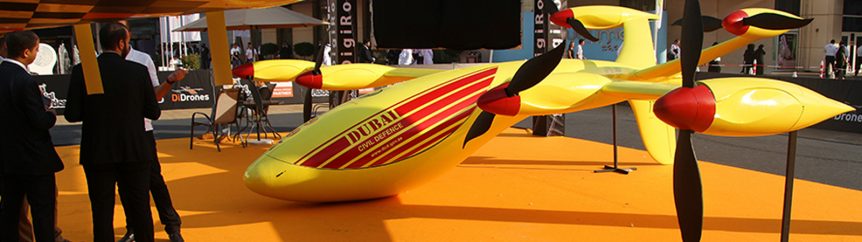
Clean Technica recently examined whether the United Arab Emirates, and especially Dubai could become a world leader in clean mobility. It lists factors such as one of the heaviest concentrations of concentration of EV charging facilities in the world, and the sizable discounts the state gives on EV ownership. The state’s relationship with electric car suppliers and readiness to test sky taxis from eHang and Volocopter add to the mix. Dubai has its homegrown flight vehicles that will add to the aerial circus in its desert skies. DGWorld, a major source of robotics in the country, has two such craft on the horizon. DG World’s Contribution The smaller of the two, the “flagship drone of DGWorld,” the UAD M20 has a 19.5 kilogram (43 pounds) maximum weight borne aloft on 2.15 meter (seven foot) wings. At least two of its six motors can tilt to allow vertical takeoffs and landings and its fixed wings enable high-speed forward flight. Able to …
Call for EAS VIII Papers
Dr. Brien Seeley, founder and president of the CAFE Foundation, shared this message today. “The CAFE Foundation is accepting presentation proposals for the 8th Annual Electric Aircraft Symposium, to be held April 25-26, 2014 in Santa Rosa, California. This international graduate level program will cover a comprehensive range of topics and will emphasize the latest breakthroughs in the rapidly growing domain of electric powered aircraft. Faculty and attendees will include experts from leading aerospace, electronics and energy companies. Topics will include aerodynamics, motors, energy storage, energy harvesting, control systems, recreational aircraft, propulsion, robotics, avionics, airspace integration, manufacturing, business cases and airport land uses. “Interested parties should email inquiries and abstracts to: cafe400@sonic.net“
Dr. Jack Langelaan and Heuristic Navigation Techniques
“Heuristic: involving or serving as an aid to learning, discovery, or problem-solving by experimental and especially trial-and-error methods ; also: of or relating to exploratory problem-solving techniques that utilize self-educating techniques (as the evaluation of feedback) to improve performance ” m-w.com (Merriam-Webster online) Dr. Jack Langelaan’s talk at the fifth annual Electric Aircraft Symposium was one of at least two to use the term, “heuristic,” and sent this writer scrambling for the dictionary. His presence in Santa Rosa, four months ahead of his return with the Green Flight Challenge winning Pipistrel G4, showed at least one of the facets to the planning that would make the G4 victorious. Careful flight planning, as any flying instructor will gladly inform you, is a prerequisite to getting the greatest efficiency out of an airplane. Historically, much flight planning involved following mapped-out air routes and flying at prescribed altitudes, at least in controlled airspace. Recent efforts to release those constraints have come about through …


