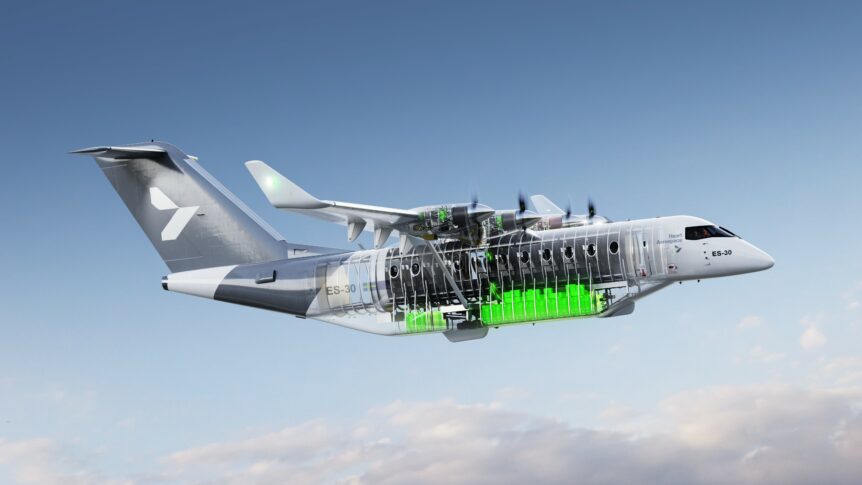
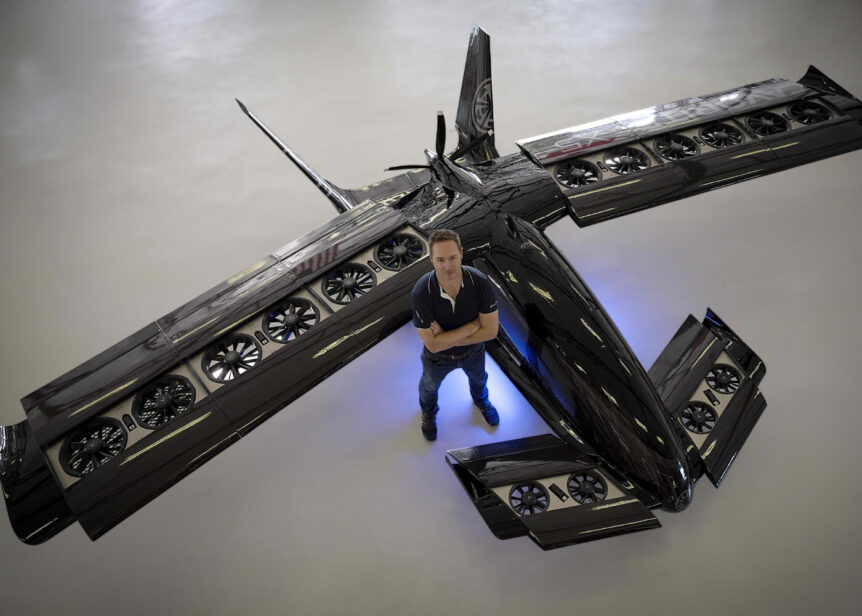
Heart Aerospace, a swedish firm with great aspirations, can breathe a little easier following the first flight of its X1, 30-passenger electric airliner. The Biggest Electric Aircaft So Far Its 30-passenger fuselage 76 feet long under a 106-foot span wing, the X1 is the largest electric airplane to fly, if you don’t count Solar Impulse with its 236-foot wingspan (but 5,100 pound weight — lower than that of the passengers on the X1, perhaps). At 25,000 pounds, the Heart X1 outdoes Solar Impulse five to one, carrying that mass on half the wingspan, How did Heart’s designers enable landings on short regional runways? Nacelle Patents One would normally consider enlarging the wing to lower landing speeds and allow landings on shorter regional runways. Heart designers chose to concentrate on nacelle design instead. A September 11, 2024 press release revealed Heart’s thinking on improving flight and landing characteristics. “Heart Aerospace, the Swedish hybrid-electric airplane maker, has filed two EU design applications …
Beta Flies at Oshkosh, Farnborough
A Hit on Two Continrnts Beta Technologies’ Alia CX-300 displayed its form and function at AirVenture 2026 in Oshkosh, Wisconsin and at the Farnborough International Air Show in England. The static and aerial exhibitions marked Beta’s ongoing devolopment of its aircraft, charging technology and network, and partnerships throughout America and Europe, and in much of the rest of the world. Beta at AirVenture The Beta Alia was on display outside the Innovation Pavillion and in the air during the evening air shows, its quiet passes in marked contrast to the raucous noise from other aircraft. A bit long at 17 minutes, and a demonstration of Flight Chops’ aerial photography acumen, the video manages to highlight Alia’s economy of operation. $2.40 for the six-minure air show routine would not cover the cost of taxiing even an ultralight from the flight line to the runway. That Kyle Clark could perform a full-power sequence, return to Appleton (about 25 miles north) and land …
Jean-Baptiste’s Disruptive Electrifly-in Win
Jean-Baptiste Loiselet is a disruptive force seemingly immune to conventional thinking. Funding what he calls a “hybrid” aircraft from his life savings, he has flown his solar sailplane around France, set a world altitude record for electric microlight aircraft, demonstrated its airworthiness at the 2024 Paris Air Show, and recently won his third Electrifly-in award at Bern, Switzerland. The term “disruptive” is one of esteem in high-tech America, but translated into French, the hashtag “rupture” leads to Jean-Baptiste’s LinkedIn site or even to his Des Ailes pour la Planète (Wings for the Planet) website. The following, a translation of the original French, shows how words can be misapprehended. “⚡️ Rupture or not rupture? (disruption or not disruption? Your editor’s interpretation.) “🏆 For the third year in a row, I’m at the top of the podium in Electrifly-In Switzerland for the sole reason that I’m the only one in my category: hybrid. “🌱 Hybrid because the Sol.Ex. is a bit of …
Regent Viceroy Seaglider: Foiling Above the Waves
The Regent Viceroy Seaglider completed its first lift-off on its hydrofoil lifting surfaces, gliding as its name suggests above the (placid) waves of Kingston, Rhode Island. Of course, that lift is helped by the 65-foot wing, making this a commercially feasible WIG (Wing In Ground Effect) machine. We have reported on earlier versions of the machine three years ago and late last year. The configuration has changed from eight motors to twelve, but the overal concept has remeained the same. This configuration has many advantages. The hydrofoils elevate the craft out of the water and lessen any hull drag on it significantly, enabling it to glide above, rather than plough through the water. Operatoing in three different modes, the craft can go from navigating crowded harbors to skimming oceans along seacoasts. Simplicity of Operation In full flight mode, the wing operates in ground effect, a cushion of air roughly equivalent to the craft’s 65-foot span. Flying at this altitude enables …
VoltAero Unveils Production Cassio 330 at Paris Air Show
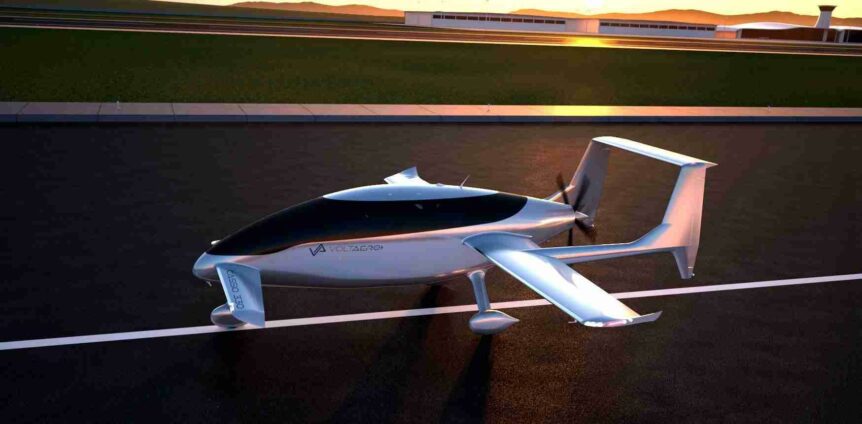
VoltAero has unveiled its production Cassio 330 hybrid electric aircraft at the Paris Air Show 2025, revealing a new look and revised, simplified technology. Aerotime explains the craft is a result of VoltAero working with the European Union Aviation Safety Agency (EASA) airworthiness certification agency. The original twin-boom configuration has been replaced with a T-tail, and its original parallel-hybrid power train with an internal combustion (thermal) engine inside the fuselage and two aft-fuselage-mounted Safran ENGINeUS smart electric motors on each side of the fuselage under the T-tail. The internal combustion engine drives a generator that recharges the airplane’s onboard batteries in a serial hookup. Changing to a single fuselage eliminates the potential of damage to the twin booms if a propeller blade fails. VoltAero explains, “The new configuration has a fully redundant architecture for operational safety. This begins with the two aft-fuselage-mounted Safran ENGINeUS smart electric motors, placing the Cassio 330 in the multi-engine aircraft category and opening its potential use in commercial …
Sustainability at AeroExpo2025: Klaus Ohlmann’s Stemme Hybrid
Klaus Ohlmann is legendary in his accomplishments. Having surmounted Mount Everest in a sailplane, traversed the Alps and the Andes in sailplanes and battery- and solar-powered craft, and contributed to wave soaring studies, he is ready to set a new type of record – one with a Stemme hybrid power system. In its sadly last post, https://www.electric-flight.eu/ left us with this news. “With a modified Stemme hybrid S10, Klaus Ohlmann wants to fly 2000 kilometers (1,243 miles).” The publication missed its headline by 1,000 kilometers (620 miles), which would make Ohlmann’s goal 1,864 miles, requiring up to 20 hours of leisurely travel. Stemme has long relied on a unique distribution of power components, with a fossil-fuel-powered engine behind the pilots, a shaft passing from its power takeoff between the two occupants to a forward-mounted, cleverly-concealed propreller tucked into a sliding nose cose. The layout is similar to that of the P-39, and later P-63 Bell Airacobras of WWII. Despite the …
Sustainability at AeroExpo2025: Alphafrog
This year’s AeroExpo was particularly supportive of sustainability, with green balloons over “green” displays, a series of seminars on electric, hydrogen, and other clean skies aspirants, and flight demonstrations showing how far the industry and the Friedrichshafen exhibit have come. Alphafrog’s Illustrious Ancestor Alphafrog is a reintroduced and wildly updated ultralight from the 1970s, the Sirocco. Its high wing, pusher engine, and forward cockpit made for a comfortable way to cruise at leisurely speeds while avoiding the rigors of more open aviating. Even the original 1983 version, a wire-braced monoplane with three-axis control, had a polyester fiber-glass fuselage and fiber-glass leading edges on wings and tail surfaces. Spars were “bidirectional stratified” composite construction. (Burger-Burr’s Ultralight Aircraft of the World, 1983, a Foulis Aviation Book) The original, even with a partially-open cockpit, was capable of an around-the-world tour. As Alphafrog relates, “Forty years ago, on September 29, 1984, Patrice Franceschi embarked on the first circumnavigation of the world with an ultralight …
ElFly Looks to the Future
Elfly, the recently-formed Norwegian aircraft company, looks to a future of responsible, emission-free flight with its nine-to-thirteen passenger amphibians. Three partners, Eric Lithun (Chief Executive Officer), Tomas Brødreskift (Chief Technology Officer), and Eirik Sandal (Chief Financial Officer), are dedicated to making electric flight along the seaside an everyday occurrence. Lithun was interviewed about the new machine and explained its benefits. Note the humility of the team’s vision and their willingness to learn during the development process. As Lithun explains, they can save funds by staying in the nine-passenger mode and expanding with market opportunities. That market may be imminent, with recent announcements of letters of intent Recent interest jumped after a “dry spell” during which Lithun had difficulty finding interest in his “niche” seaplane. That now seems over with Danish operator Nordic Seaplanes signing an agreement for 15 Noemis. This would make Nordic, the only European operator of scheduled seaplane operations, as Elfly’s first customer. Contingent on Noemi’s certification …
Electra Aero Announces Nine-Seat uSTOL
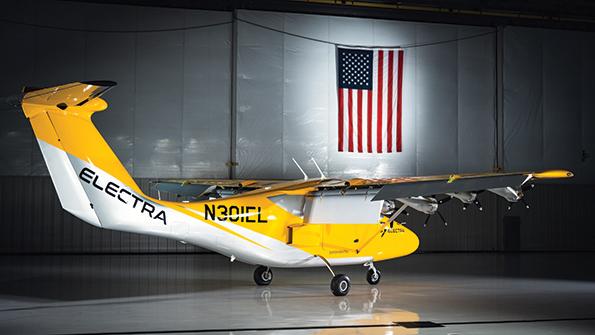
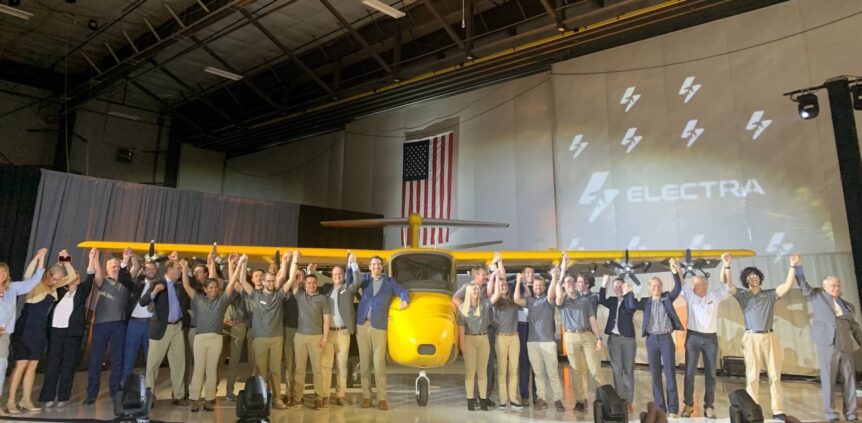
Moving from a technology demonstrator to a full-scale nine-seat uSTOL (ultra Short Take Off and Landing) prototype, Electra Aero is showing significant progress in flight that can take advantage of unprepared fields, and pocket airparks that could conceivably serve neighborhoods. Since its introduction, the Electra Aero Goldfinch has demonstrated on a small scale what Electra hopes to achieve with its blown-wing technology on a nine-seat commuter craft. The Goldfinch has drawn the attention of the military. It repeatedly demonstrated its ability to take off and land within 150 feet, and its overall arrival and departure flight path emulates that of helicopters. Test pilot Cody Allee has shown the craft’s ability to land and take off on unprepared surfaces and to maintain control in 150-foot diameter turns before both the Air Force’s AFWERX program and Navy audiences. That maneuverability speaks well for its potential combat use. The video overview below of Electra’s history gives a good idea of the company’s design …
The Villiger Traveler – A Stunning Resemblance
The Villiger Traveler is a Swiss aircraft that looks remarkably like the SmartFlyer SF-1 featured in our last posting. Despite the similar styling, the Traveler has a unique history of its own, and a few stable mates that reflect its careful engineering. The Traveler 230 First introduced in 2017, the Traveler was derived from the TR230, a Cessna-like craft designed with assistance from Calin Cologan and others. The conventional aircraft, based on other works from this group, was probably Swiss precise in its manufacture. But a different approach and less conventional look were on their way. Same Name, Different Approach Possibly taking the same approach as that taken by the SmartFlyer group, the Villiger team designed a similar appearing airplane, but with two initial variants that gave them some flexibility in choosing components. Carrying on e-Genius’ Platform By 2019, the Villiger craft was probably set in plastic, so to speak. Such designs have to be “dialed in” early, and because …