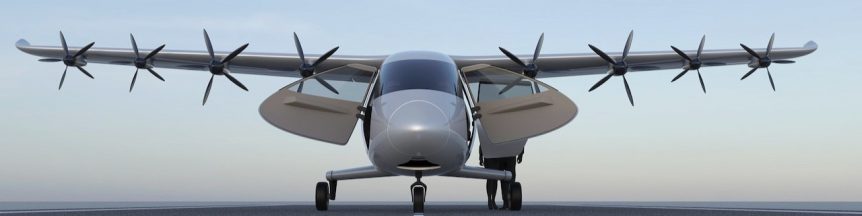
The Pivotal Helix eVTOL (electric Vertical Take Off and Landing) Aircraft “Gains Warm Response from California Fire Agencies in Multi-Agency Demonstration Series.” That’s the headline for a Pivotal press release on its recent demonstration for three southern California fire departments. Seeming to be almost a response to Dr. Brien Seeley’s recent front-page opinion section editorial in the San Francisco Chronicle, Pivotal’s live show helped emergency responders see how rapid aerial response could aid their missions. Dropping in on stations at the San Bernardino County Fire Department, Southern Marin Fire District (SMFD), and Cosumnes Fire Department, Pivotal personnel gave flight demonstrations and let firefighters try their hand at simulator flying. As Pivotal’s press release notes, “Each demo showcased the potential of Pivotal’s single-seat aircraft to dramatically improve emergency response capabilities, especially in locations where time, terrain and traffic can mean the difference between life and death.” Ken Karklin, CEO of Pivotal, added, “Our aircraft offers a cost-effective, rapidly deployable solution …
Dr. Seeley Makes the Chronicle
Dr. Seeley Hits the Front Page Dr. Brien Seeley’s editorial on the front page of the San Francisco Chronicle’s opinion section July 14, is a well-reasoned appeal to try a radical new approach to fighting wildfires. It impressed an editorial board enough to make it their featured Op-ed leading their Sunday coverage. It’s the product of Dr. Seeley’s decades-long research into short-take-off and landing (STOL) aircraft and his drive to make small airplanes emissions-free. It’s also a challenge to American ingenuity and technology to help save us from the current plague of pollution and resulting wildfires. These don’t take place only in remote backwaters like Paradise, California, but now even in once-protected enclaves such as Pacific Palisades and Beverly Hills. Dr. Seeley makes three big points in his editorial. One, we have the technology to fight wildfires today, products of the high-tech industries in which California abounds. Two, carbon dioxide emissions from wildfires are more than twice those from our …
FireSat: Spotting Wildfires Early and Responding Quickly
FireSat may be part of a solution to our world’s growing wildfire problem. Recent events, such as the conflagrations ravaging Los Angeles, resulted in widespread damage and enormous loss of lives and property. Spotting fires early on would allow quicker response, and with the appropriate gear, swift quelling of the flames before they became a tragic threat. Sending information to a fleet of piloted or unpiloted craft, early warnings from Firesat satellites could direct a swift response that would prevent the growth of incipient wildfires. Fifty such low-earth orbiting watchdogs would use their highly-specialized optics to focus on the beginnings of a fire, as small as 5 x 5 meters (16.4 feet x 16.4 feet). Finding Fires Earlier and With Greater Accuracy Juliet Rothenberg, Product Director of Climate AI efforts at Google Research, has helped develop the FireSat program, in response to the hurried evacuation of her home four years ago when a wildfire threatened her neighborhood. Then available satellite …
Electra Aero Announces Nine-Seat uSTOL
Moving from a technology demonstrator to a full-scale nine-seat uSTOL (ultra Short Take Off and Landing) prototype, Electra Aero is showing significant progress in flight that can take advantage of unprepared fields, and pocket airparks that could conceivably serve neighborhoods. Since its introduction, the Electra Aero Goldfinch has demonstrated on a small scale what Electra hopes to achieve with its blown-wing technology on a nine-seat commuter craft. The Goldfinch has drawn the attention of the military. It repeatedly demonstrated its ability to take off and land within 150 feet, and its overall arrival and departure flight path emulates that of helicopters. Test pilot Cody Allee has shown the craft’s ability to land and take off on unprepared surfaces and to maintain control in 150-foot diameter turns before both the Air Force’s AFWERX program and Navy audiences. That maneuverability speaks well for its potential combat use. The video overview below of Electra’s history gives a good idea of the company’s design …
MagniX Powers a Dash 7
MagniX Motors in Everett, Washington looks forward to powering a short-field performance champion, the DeHavilland Dash 7. The Dash 7 is a pretty astonishing short field aircraft, emulating the bush planes of the far north, home to its Canadian maker. Measuring its take-off and landing capabilities, this video shows what four Pratt & Whitney PT-6 turbines can do for a 40,000 pound airplane. As shown, the craft can carry heavy load from and into some pretty isolated territory without the need for sophisticated airport support systems. The idea of such performance and load-hauling is not a new idea, World War Two, and subsequent conflicts demonstrating the need for the need to get in and out of scarcely viable landscapes. To drive the point home, here’s a second video of a Dash 7 landing with 5,700 liters (10,088 pounds) of Jet-A on board. Not only is it a short landing but a very precise one, the main gear staying within bounds …
Yelling Fire on a Crowded Planet
The earth is on fire. That’s not some Sierra Club hyperbole, but a factual assessment of where we are as a planet. Your editor has woken (for three days now) coughing and inhaling the smoke and ashes from a small-potatoes, 300-acre forest fire 15 miles away. The rest of Oregon is suffering far more. Throughout America and the world, forests, brush lands, prairies and savannahs are being ravaged at record levels. The National Interagency fire Center illuminates the alarming numbers. “As of this morning (August 14), 75 large active wildfires are being managed with full suppression strategies nationwide. Current wildfires have burned 2,337,468 acres. More than 26,000 wildland firefighters and support personnel are assigned to wildfires, including 21 complex and 5 Type 1 incident management teams, 578 crews, 1,357 engines, 152 helicopters, and six Modular Airborne Fire Fighting Systems, or MAFFS. Sixty fireline management personnel from Australia and New Zealand are assigned to support large fires in the Northwest Area.” Note …
H3X HPDM-3000 – a Three Megawatt-Motor?
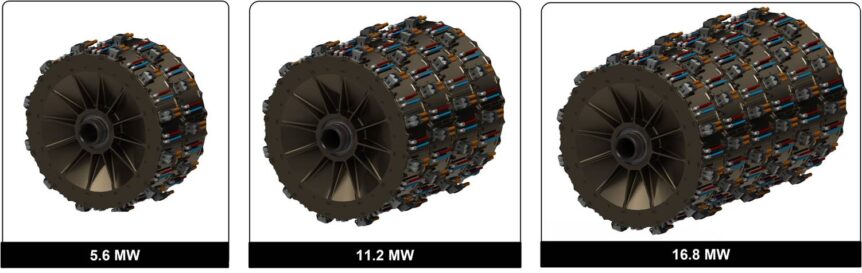
H3X is shaking things up with its announcement of its HPDM-3000, a three megawatt motor. Thirteen years ago, your editor gave his first presentation at an electric aircraft symposium, held that year in the Hiller Aviation Museum in San Carlos, California. Dr. Brien Seeley, founder and then head of the CAFE (Comparative Aircraft Flight Efficiency) Foundation, had asked for research on motors of 100 kilowatts or more. It was hard to find units of over 50 kW at that time, but people like Roman Susnik were managing ultralight motors of over 100 kW for motorized sailplanes With competitors like MagniX and ZeroAvia in the game, H3X introduces the HPDM-3000, a 2.8 mW (3,753 horsepower) ultra-high power density integrated modular motor drive (IMMD). Developed by a group of young graduates of the University of Wisconsin at Madison, H3X’s motors combine extreme lightness for the power produced with cutting edge manufacturing techniques. In this video, Chief Technology Officer Max Liben explains the …
Two Similar eSTOLs
Two different but very similar electric Short Take Off and Landing (eSTOL) aircraft from two different companies are making progress toward realization. Both are products of teams originally committed to electric Vertical Take Off and Landing (eVTOL) designs, so the shift to different configurations is of interest. eVTOLs are limited in range by the need to lift their entire weight on their rotors – some for the totality of the flight. eSTOLs use aerodynamics to enable longer range, and with high-lift devices, can use small fields from which to operate. Dr. Brien Seeley, head of the Sustainable Aviation Foundation, has been a long-time proponent of what he called “pocket airparks.” These neighborhood or urban sites would be contained within roughly one-block perimeters, use aircraft capable of extremely short takeoffs and landings, low noise, and quick turnarounds. Electric aircraft and their quiet operation would allow placing such airparks in more areas and could make access to air travel as common as …
From Ganged Motors to Wright’s Two MegaWatts
Twelve years ago, your editor gave his first talk at an electric aircraft symposium. Dr. Brien Seeley asked that he include all motors up to 100 kilowatts in his talk – at that time a rarity. Designers often had to “gang” small motors to drive a single propeller to obtain the necessary power. Now, Wright Electric has announced its plans to develop motors (and associated equipment) in the 500 kilowatt to 20 megawatt range. Motors of those sizes are still under development, but Wright claims to have tested and demonstrated “a megawatt-class, high performance inverter,” according to Green Car Congress. Jeff Engler is getting recognized for his vision. Here he give his virtual elevator speech at the Davos, World Economic Forum. His positive and yet measured approach seems to gain acceptance for that vision. Demonstrated Performance? Aiming for some audacious levels of performance, Wright’s inverter could hit these metrics: “99.5% efficiency –a 6x improvement in heat loss over current in-production …
Sustainable Aviation Symposium 2019
The 2019 Sustainable Aviation Symposium is moving to a new date and location – and a new inclusiveness. The University of California, Berkeley Institute for Transportation Studies (ITS) will host the 2019 Sustainable Aviation Symposium (SAS) on October 7-8 of 2019. SAS 2019 is focused on safe, quiet, electric aviation solutions to the most pressing problems of our age: climate change, urban surface gridlock, and the need for integrated community and urban planning to enable high proximity aviation at meaningful scale. Dr. Jasenka Rakas, founder and head of the Airport Design Studio at the University of California at Berkeley, and Sustainable Aviation Foundation founder and President Dr. Brien Seeley will co-chair the meeting that will present a challenging review of aviation’s green future. This year’s symposium will convene thought leaders to answer these core questions: Which systems will win a dominant share of the market and why? How will “urban air vehicles” be made “airline-safe” and autonomous? What new technologies are …