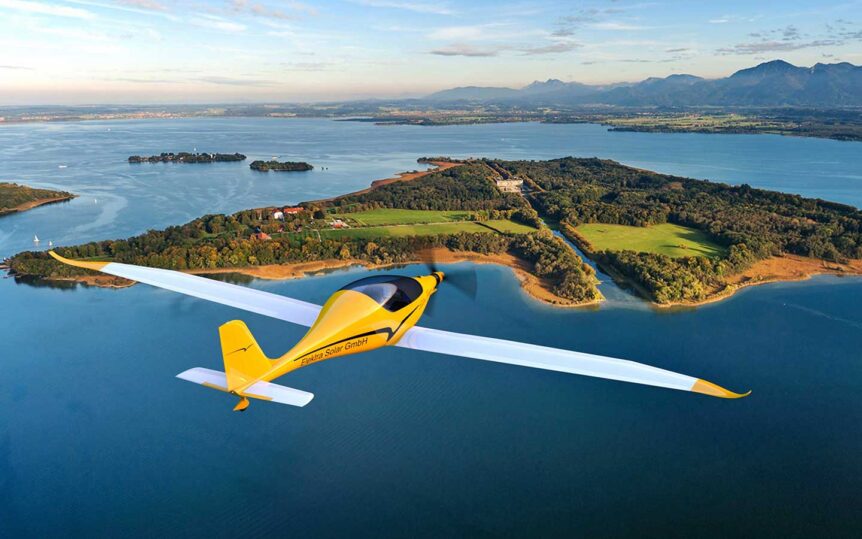
Jean-Baptiste Loiselet is a disruptive force seemingly immune to conventional thinking. Funding what he calls a “hybrid” aircraft from his life savings, he has flown his solar sailplane around France, set a world altitude record for electric microlight aircraft, demonstrated its airworthiness at the 2024 Paris Air Show, and recently won his third Electrifly-in award at Bern, Switzerland. The term “disruptive” is one of esteem in high-tech America, but translated into French, the hashtag “rupture” leads to Jean-Baptiste’s LinkedIn site or even to his Des Ailes pour la Planète (Wings for the Planet) website. The following, a translation of the original French, shows how words can be misapprehended. “⚡️ Rupture or not rupture? (disruption or not disruption? Your editor’s interpretation.) “🏆 For the third year in a row, I’m at the top of the podium in Electrifly-In Switzerland for the sole reason that I’m the only one in my category: hybrid. “🌱 Hybrid because the Sol.Ex. is a bit of …
Solarstratos’ New Altitude Record
Raphael Domjan’s SolarStratos set a new world altitude record for solar-powered aircraft, 9,521 meters, or 31,237 feet, on August 12, 2025. That CBS News and other press outlets saw fit to cover the event is a significant change in coverage from just having the normal technical details explained in the aviation press. The network explained, “The SolarStratos plane made the landmark flight from Sion airport in southwest Switzerland on Tuesday, taking advantage of warm air thermals to go beyond the record that has stood for 15 years. (That record was held by Andre’ Borschberg in the Solar Impulse.) “The certified altitude record for a solar plane stands at 9,235 meters, or 30,298 feet. “The achievement is ‘one of those unforgettable peaks that define great human and technological adventures,’ the SolarStratos mission said in a statement.” CBS noted the moment when Solarstratos crossed paths with a commercial airliner, “a powerful symbol of what the decarbonized aviation of tomorrow might look like.” …
A Good Friend, Richard Steeves, Passes
Richard Steeves, a good and dear friend has passed, known for his achievements in medicine and among his friends for leading a long-term aviation club and even constructing a Coot Amphibian and electric ultralight airplane. Many will know him from his leadership of the Coot Builder’s Club, a group of enthusiasts who build and fly Molt Taylor’s design. The organization publishes a newsletter that Richard edited for an astonishing 50 years. He became great friends with Moulton (Molt) Taylor, the designer of the Coot, and wrote books and articles about the amphibian. Now, with Richard’s passing, Andrew Wayne will take over running the organization and publishing the newsletter, which promotes the continued building and flying of this craft. In the early days of aircraft home-building, enthusiasts had to find plans for their intended craft, materials, and if possible, supportive local help. This made building a Coot especially challenging. Managing construction of a complex airplane with retractable landing gear, and mastering …
Sustainability at AeroExpo2025: Alphafrog
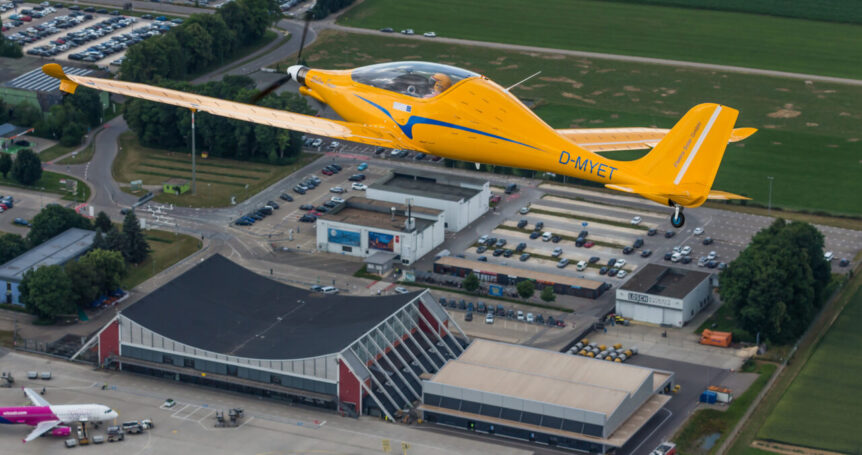
This year’s AeroExpo was particularly supportive of sustainability, with green balloons over “green” displays, a series of seminars on electric, hydrogen, and other clean skies aspirants, and flight demonstrations showing how far the industry and the Friedrichshafen exhibit have come. Alphafrog’s Illustrious Ancestor Alphafrog is a reintroduced and wildly updated ultralight from the 1970s, the Sirocco. Its high wing, pusher engine, and forward cockpit made for a comfortable way to cruise at leisurely speeds while avoiding the rigors of more open aviating. Even the original 1983 version, a wire-braced monoplane with three-axis control, had a polyester fiber-glass fuselage and fiber-glass leading edges on wings and tail surfaces. Spars were “bidirectional stratified” composite construction. (Burger-Burr’s Ultralight Aircraft of the World, 1983, a Foulis Aviation Book) The original, even with a partially-open cockpit, was capable of an around-the-world tour. As Alphafrog relates, “Forty years ago, on September 29, 1984, Patrice Franceschi embarked on the first circumnavigation of the world with an ultralight …
FireSat: Spotting Wildfires Early and Responding Quickly
FireSat may be part of a solution to our world’s growing wildfire problem. Recent events, such as the conflagrations ravaging Los Angeles, resulted in widespread damage and enormous loss of lives and property. Spotting fires early on would allow quicker response, and with the appropriate gear, swift quelling of the flames before they became a tragic threat. Sending information to a fleet of piloted or unpiloted craft, early warnings from Firesat satellites could direct a swift response that would prevent the growth of incipient wildfires. Fifty such low-earth orbiting watchdogs would use their highly-specialized optics to focus on the beginnings of a fire, as small as 5 x 5 meters (16.4 feet x 16.4 feet). Finding Fires Earlier and With Greater Accuracy Juliet Rothenberg, Product Director of Climate AI efforts at Google Research, has helped develop the FireSat program, in response to the hurried evacuation of her home four years ago when a wildfire threatened her neighborhood. Then available satellite …
Turning Over an Old Leaf: Reusing Lithium Batteries
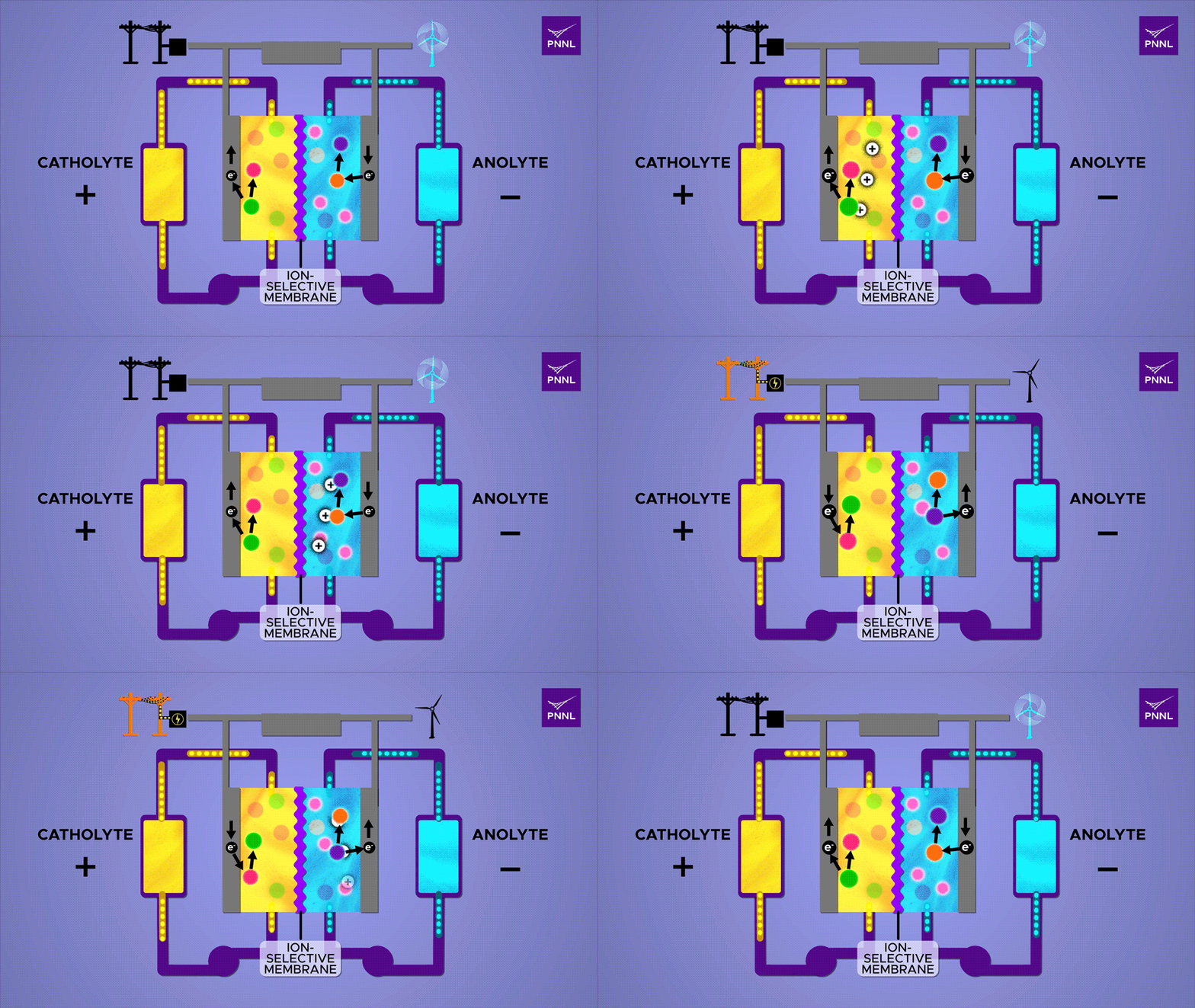
Turning over an old Leaf (of the species Nissan) and reusing its batteries may be a partial answer to the shortage of lithium. The energetic metal is hard to get and often in short supply. In several entries to come, we’ll try to find some answers to questions about sourcing battery materials, how safe we can make batteries, and what future batteries may be like. When Weight is no Object When you don’t need to consider weight as part of your battery needs, as in ground-based energy storage units, why bother with lithium? It’s potentially explosive, so find elements that are less so, although sometimes heavier. Or, in some uses, use all the potential from existing sources that no longer live up to their specifications. Electric cars need a change of battery packs, for instance, when their cells can manage only 80 percent or so of their original range. One solution in Lancaster, California, B2U uses old Nissan Leaf battery …
A Survey For Green Aviation Lovers
Jean-Baptiste Loiselet has a survey for those interested in green aviation to participate in. He’s been riding the electric skies for three years without going anywhere near an electric plug. He wants to know if others would like this kind of free flight. Imagine flying for three hours at a time, quietly in an environmentally responsible way. GREEN AVIATION? SPECIAL MESSAGE FOR MICROLIGHT PILOTS AND AIRPLANES 🎤 We need your opinion. 🛫 I’ve been flying aboard the Sol.Ex., my solar glider for 3 years now. It has more than 250 hours of flight time to date and has never been plugged into a socket, while I take off all the time independently! 👫 I plan to develop the two-seater version of the Sol.Ex., to be able to share this fabulous adventure. And if the electric motor glider (solar or simply electric) is of obvious interest for gliding, I wonder if it would not also be interesting for all light aviation …
Solar Altitude Record and Tour de France
Une Homme of Accomplishment Jean Baptiste Loiselet is an accomplished person, setting a recent ultralight solar altitude record in his own ultralight sailplane. That is only one of his many exploits. He has been part of a small crew on the remote Kerguelen Islands, between the southern tip of Africa and Australia, and north of Antarctica. With supply ships only four times a year, Jean Baptiste had to be well organized and resourceful to maintain the equipment necessary for life at the IPEV (French Polar Institute Paul-Émile Victor). His work with Remotely Operated Vehicles (ROVs) required full responsibility for everything from preparing requests for equipment, recruiting a team, and purchasing the needed equipment including ROVs. Administratively, he wrote operational procedures, managed the site and and remote operations, and created reports and oversaw invoicing. These became important elements in crafting his own solar aircraft. Beyond his duties on Antarctic expeditions, he works with young people as part of The AJD – …
Climate Impulse – Not at All Impulsive
Born of the heritage of the Solar Impulse Foundation and taking it further, Climate Impulse wants to showcase concrete technologies that can revolutionize the aviation industry, and the mobility sector in general. Two Well-Travelled Partners We are all familiar with the exploits of Bertrand Piccard, which include the first circumnavigations of the globe in a balloon and more recently in a solar aircraft. He comes from a family of explorers who have climbed the heights and plumbed the depths of our world. We are probably less familiar with an equally intrepid adventurer, Raphael Dinelli. Dinelli attempted a solar circumnavigation of the globe as part of the 1996-1997 Globe Vendee competition. He didn’t quite make it full circle, sinking in the Indian Ocean. The Australian Air Force dropped a life raft to him and then he was pulled to safety by another competitor, Peter Goss. According to Wikipedia, “He went on to sail with Goss in the 1997 edition of the …

Amprius Batteries Fly High and Down Under
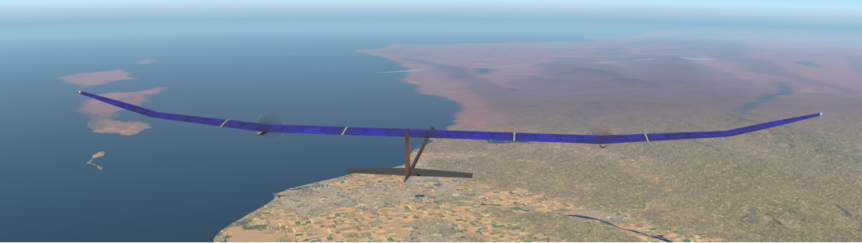
Flying high and down under, Amprius, the San Francisco Bay area-based battery developer and maker, announced 450-Watt-hour per kilogram cells, and seemingly immediately secured orders from three major clients. One client of the three is a British specialist in HAPS (High Altitude Pseudo Satellite) aircraft. A probably unrelated sale went to an Australian light plane maker unveiling the country’s “first commercially produced electric aircraft,” a two-seat trainer. BAE/Prismatic BAE Systems has collaborated with Prismatic, a HAPS pioneer, in the development of solar-powered unmanned aerial vehicles (UAVs). The partners have crafted two prototypes of the PHASA-35 unpiloted aerial vehicle, a 35 meter (114.8 feet) span airplane weighing 150 kilograms (330 pounds) capable of carrying a 15 kilogram (33 pound) payload. Solar cells power the craft’s electric motors during the day and charge the Amprius batteries that keep it in the air at night. Amprius claims, “The new 450 Wh/kg cells are the only known commercially available batteries of their kind that …